Blog

  • Fed up with ultra concentrated media power? Join Better Media

    Fed up with ultra concentrated media power? Join Better Media

    If we want peace, justice and sustainability we need land, money and media reform.

    Land and banking reform are the big ones, but we need media reform first; without it we’ll never have the quality of public discourse needed to bring about wider systems change.

    As activist and author David Korten once put it:

    The key to changing the course of the human future, is to change the stories by which we live.

    But the UK media reform movement consists of handful of mostly very small and massively under-resourced groups and organisations who just about manage to punch slightly above their rather slight weight.

    To have a fighting chance of ever fulfilling our aims, we need to think bigger. That’s where Better Media comes in.

    Our goal is to build a large scale democratic movement to organise, fund and support campaigns for Better Media in the UK. A “Greenpeace for the media“, if you like.

    Right now, despite growing numbers of people recognising the dire need for media reform in the UK, there is no default membership organisation for these people to join and support with a monthly direct debit.

    The Media Reform Coalition (MRC) and Hacked Off both formed in response to the phone hacking scandal in 2011, and more recently Stop Funding Hate has risen to prominence. But unlike the CPBF, none of these have union-organised media workers at their core, and none are democratic membership organisations.

    As the only democratic membership organisation in the space CPBF is the closest thing to what needs to exist: but it’s 20th century name and organisational structure are no longer fit for purpose, and it’s closing down.

    The Better Media idea is simple: get everyone who recognises the need for Better Media to routinely contribute funds to help make it so.

    How will it work?

    Better Media is a transparent co-operative endeavour, empowered by collaborative open source tools.

    Everyone can see where all our money comes from, and how it is spent.

    Everyone who signs-up as a contributor is invited to join our online organising and decision-making spaces.

    At present we use the Sandstorm.io (an open source platform for easily and securely self-hosting web-based productivity apps) to run WeKan (a Trello clone), Rocket.Chat (Slack clone), and Etherpad (collaborative document editing), together with a WordPress website, a Discourse forum for discussions, and Loomio for decision-making.

    Exactly what Better Media becomes will depend on what we do together, but to begin with we’ll be rallying around the proposals in the MRC and CPBF’s Manifesto for Media Reform:

    • Controls on media ownership
    • Independent, trusted and effective regulation of the press
    • Well-funded, independent public service media
    • Protection for communication rights
    • Action on lobbying and transparency

    If this sounds good, sign-up as a regular contributor now: https://opencollective.com/bettermediauk

    Together we can build the movement for #BetterMedia the UK so desperately needs.

    An edited version of this article was first published in CPBF’s journal Free Press No 216.
  • New Report: Who Owns the UK Media in 2019?

    New Report: Who Owns the UK Media in 2019?

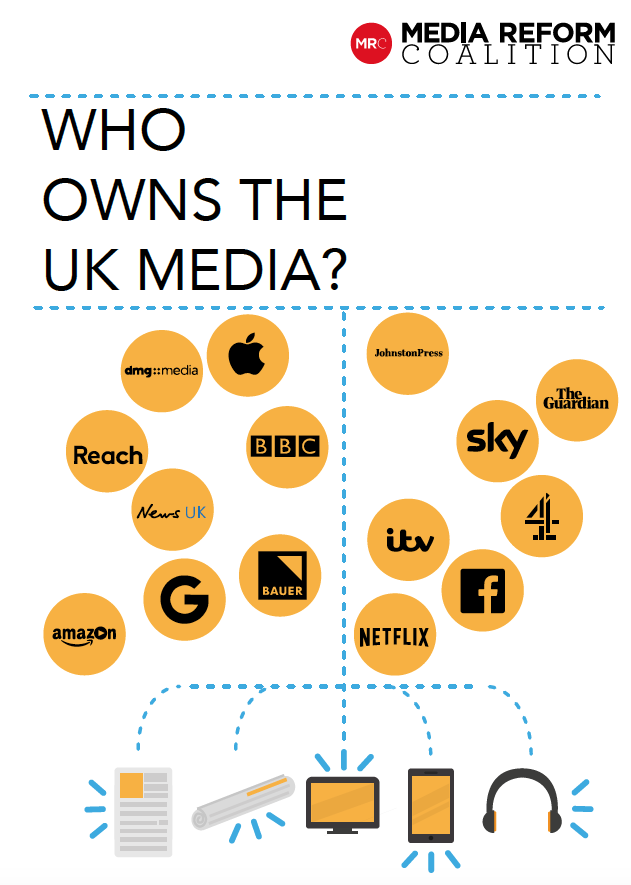
    We produced our first comprehensive report on media ownership in the UK back in 2015 when we argued concentrated ownership was a significant problem for any modern democracy. Four years later, we have produced an updated version that suggests that, not only does concentrated ownership persist but that the problem may be getting worse.

    This report shows that just three companies (News UK, Daily Mail Group and Reach) dominate 83% of the national newspaper market (up from 71% in 2015). When online readers are included, just five companies (News UK, Daily Mail Group, Reach, Guardian and Telegraph) dominate nearly 80% of the market, slightly up from our last report. In the area of local news, just five companies (Gannett, Johnston Press, Trinity Mirror, Tindle and Archant) account for 80% of titles (back in 2015, six companies had the same share). Two companies have 46% of all commercial local analogue radio stations and two-thirds of all commercial digital stations.

    The digital landscape is hardly less concentrated. Google dominates search while popular apps like Instagram and WhatsApp are owned by Facebook, itself the most popular social media site. New, digital-only news sites have emerged as a significant force since our last report but these are overshadowed by the continuing grip of legacy news and, especially, national newspaper titles.

    The BBC remains a powerful presence in online and broadcasting but its budget has been massively cut by the last two licence fee deals and its room for manoeuvre has been limited by commercial competition and political pressure to be mindful of its impact on the wider commercial market.

    We believe that concentration in news and information markets in particular has reached endemic levels in the UK and that we urgently need effective remedies. Concentrated ownership creates conditions in which wealthy individuals and organisations can amass vast political and economic power and distort the media landscape to suit their interests. Urgent action is needed in order both to address high levels of concentration in particular media markets and to protect against further concentration in others.

    We hope that this report will provide data and arguments that will be useful to all those who want to campaign for a more pluralistic media in which a genuine diversity of views, voices and opinions are aired.

    To see the full report, click here.

    For the executive summary, click here.

    For all the data sheets, click here.

    If you have questions or want a hard copy of the report, please email info@mediareform.org.uk

  • Hands off FOI – the fight to defend the Freedom of Information Act

    Hands off FOI – the fight to defend the Freedom of Information Act

    Branch meeting, Monday 15 Feb, 6.30pm
Fifth Floor, Headland House, 308-312 Gray’s Inn Road, WC1X 8DP 
(Nearest tube: King’s Cross. Sandwiches and light refreshments provided, baby sitting and reasonable travel costs can be covered.)

    Speakers – Katherine Gundersen from the Campaign for Freedom of Information and William Turvill, Journalist at Press Gazette

    From Duckhousegate to the Prince Charles spider pen memos, the Freedom of Information (FOI) Act introduced a decade ago has helped to uncover some of the biggest scandals of recent years, news stories that have rocked the establishment and led to major shifts in public opinion.

    But since last year journalists and campaigners have been fighting to protect the Act, after a Government Commission threatened to introduce sweeping reforms that could limit our access to information drastically – such as giving MPs the right to veto disclosures and slapping prohibitive fees on FOI requests, moves that could hit investigative journalism in our sector particularly hard.

    With the Commission due to report its recommendations any time now, Katherine Gundersen from the Campaign for Freedom of Information and William Turvill, journalist at Press Gazette, will bring us up to date on progress with the campaign to defend FOI and why journalists are fighting not only to preserve the Act but to extend it even further.

    Branch AGMThe branch will hold the next Annual General Meeting at the April branch meeting. This is at 6.30pm 18 April 2016, in the Bertrand Russell Room at Conway Hall, 25 Red Lion Square, Holborn, London WC1R 4RL.

    The meeting will receive reports from the branch committee on activities, membership and finance, and will elect branch officials for the coming year.