our current media suffer from concentration of media ownership,
lack of accountability, lack of independence from government and from
commercial pressures and do not adequately represent a diverse range of
people and views;
a flourishing, diverse and accountable media
is essential for a healthy, functioning democracy. Media plurality is
not a luxury in the digital age but an essential feature of a media
system in which vested interests should not be allowed to dominate;
the levels of concentration revealed in the Media Reform Coalition’s 2019 Media Ownership report ‘Who Owns the UK media’
show we need action that will challenge blockbuster media and tech
companies and the influence that flows from their dominance of
infrastructure, content and distribution;
we need independent
media that are able to hold power to account and to serve their
audiences and the public in general as opposed to shareholders,
proprietors or politicians;
we need a rebooted system of
regulation that gets to grips with the complexities of media ownership
in the twenty-first century; one that encompasses top-down measures to
check the dominance of individual or corporate interests as well as
bottom-up measures to support genuinely independent and not-for-profit
media on the ground;
we need a new system of regulation that
addresses both the enduring (and in many ways intensifying) grip of
legacy media on public debate as well as the control over news and
information ‘flow’ wielded by tech giants.
This meeting/branch/conference resolves to:
support the Media Reform Coalition’s ‘Media Manifesto 2019’
for a fair, free, accurate and representative media system that is
capable of informing and nourishing the kind of inclusive public debate
that is the lifeblood of functioning democracies;
[if relevant]
raise these proposed reforms at our party conference and to encourage
our political representatives to push for their inclusion in our party’s
policy making debates and in future election manifestos;
Please get in touch – info@mediareform.org.uk
– to invite the Media Reform Coalition to speak at a future meeting if
clarification on the policies is needed / for further information about
media reform.
We’re facing a crisis at the heart of our media system – in other
words with the dominant players across our media environment – on many
different levels: of funding, of ethics, of representation and of
legitimacy. The crisis is related, in particular, to the increasingly
unequal distribution of resources in our media landscape. This is a
landscape characterised by the domination of attention, audiences and
agendas by a relatively small number of very powerful companies – both
online and offline – all of whom have close associations with the
highest levels of our political system. I don’t for a moment think that
these organisations work together as some kind of cohesive unit – indeed
I have written extensively on the contradictions of media power
and the fact that audiences and media organisations are not always in
tune with each other and that what we call ‘the media’ refers to a
variety of different cultures, routines and institutions – but
nevertheless I do think that they share some systemic features that I
want to outline.
under a third of the UK population trust the media as a wholeThere are many elements of the media crisis but I want to focus on just three. The first concerns a problem with trust. Now
classical liberal theory tells us that our independent media ought to
be crucial instruments for holding powerful bodies to account and for
representing the views and experiences of ordinary people. They are,
after all, supposed to be ‘the fourth estate’. Yet our trust in them remains low. The most recent Edelman Trust Report
shows that under a third of the UK population trust the media as a
whole. What’s interesting is that top earners trust the media far more
than the poorest – 54% to 26% – presumably because the wealthy perceive
that the media represents their interests more adequately than do the
poorest.
It gets worse though: only 22 percent of the UK population
trusts journalists to tell the truth in contrast to the 90 percent who
trust doctors to tell the truth. This means that we have far more
confidence in the ability of surgeons to operate on journalists than we
do in journalists to report on doctors – which may tell you something
about recent coverage of the junior doctors’ strike.
Some people will tell you that this is as it should be: if
journalists are liked, then it means that they’re not asking the tough
questions which ought to make them unpopular. But this seems to me to be
the opposite of what’s happening. To the extent that we don’t trust our
news media, it’s because we feel they are far too intertwined
with the power they are supposed to be reporting on – that for every
Leveson Inquiry, there are far more opportunities for Rupert Murdoch to
pop into 10 Downing Street (as he did 10 times
in the last year) or to pop next door to speak to the chancellor George
Osborne just before the BBC licence fee deal (as he did twice);
and that for every MPs’ expenses scandal, there are far more occasions
when our news media amplify, or at least fail to challenge, a
comfortable consensus around, for example, the legitimacy of airstrikes
or Jeremy Corbyn’s alleged inadequacies or the need for austerity. To a
degree that ought to be a matter of public concern, the media are
institutions with and of power.
The second element of the crisis concerns the rapid growth of
commercial media at the expense of public media. In other words the
embedding of a market logic in communications and the weakening of both
public institutions and public accountability – the consequences of
which I have written about recently in openDemocracy.
The third feature of the crisis in media concerns the ‘evisceration’
of the meaning of key policy objectives by neoliberal actors. We can
see this in particular in relation to debates concerning media pluralism
and press freedom. Pluralism is the concept that’s used in Europe to
denote the fact that we need to have a sufficient number of outlets that
support a range of diverse voices. This is supposed to be a
foundational principle that does two things: first, to provide citizens
with a full range of information and, second, to break up undue
concentrations of power. But recent policy debates have been dominated
by a commitment to secure pluralism that sees it not in terms of the
fair distribution of media power but as overwhelmingly related to the
promotion of consumer choice: of maybe making the menu a little longer
but not really looking at what is on the menu itself.
There is a similar evisceration of the meaning of press freedom
whereby the ability of journalists to hold power to account through
independent investigation and to secure their citizens’ right to know
has been squeezed by a new determination to associate such liberties
with the rights of corporations to speak as they wish. In the UK, there has for the last few years been a fierce – and thus far highly effective – backlash
against government proposals for a new Royal Charter on press
self-regulation led by newspaper proprietors claiming that they and
their titles are the only guarantors of press freedom. This is
despite the fact that it was their activities – the industrial scale
phone hacking, the privileged access of proprietors to politicians, and
the press’ refusal to tolerate a fully independent audit of its
activities – that have so massively lowered the credibility of many news
organisations in the public’s eyes.
how do we restore public trust,
curb the power of unaccountable groups to dominate media spaces and
introduce more robust policy principles?So, what do we do about
these problems: how do we restore public trust, curb the power of
unaccountable groups to dominate media spaces and introduce more robust
policy principles? Well this is where media reform comes in as we need
to do three things: to be the media, know the media and change the
media.
The first dimension of media reform acknowledges that if publics
cannot rely on the most powerful existing instruments of media to
adequately represent their lives as they are lived and to hold power to
account, and if we have online environments which are all too often
replicating the monopoly structures and commercial orientations of the
analogue systems which they were supposed to have replaced, then we need
to do something different: to make our own media, to tell our own
stories and to highlight our own voices. This relates to the theory and
practice of alternative media which draws on participatory accounts of
democracy to produce media that better engage with and reflect
the diversity of the population. Alternative news outlets, for example,
aim to produce content that goes beyond what they see as the false
objectivity of mainstream news while community media tend to avoid
sensationalist and commercial formats with voices and methods that seek
to be more democratic and to talk in the language and register of their
audiences.
The second response to the problems we face is to better understand
the content, practices and structures of established media structures.
This, of course, is at the heart of the field of media studies – a
discipline that has long been dismissed as a ‘Mickey Mouse’
subject filled with ‘sub-Marxist gobbledegook.’ By encouraging critical
readings of popular texts and institutions, media academics aim to
grasp the complex dynamics of these hugely important structures except
that we are then accused of glorifying the trivial, the temporary and
the talentless.
But we’re also told the opposite: that we – media academics – are
glorifying something much worse. Social services in one London borough
recently produced a leaflet
aimed at combating signs of radicalisation arguing that “showing a
mistrust of mainstream media reports” could be evidence that children
are being groomed by extremists. The only radicalisation strategy that
interests me in my work is one that relates to cultivating the ability
of students to think independently and critically and not to take for
granted the symbolic mechanisms that attempt to render certain stories
natural and familiar: for example that men are natural ‘experts’
given their systematic over-representation in appearances on broadcast
news or that benefits claimants are ‘scroungers’ as we have seen in a
whole slew of ‘poverty porn’ programmes.
Yet, as valuable as alternative media and critical knowledge surely
are, I would nevertheless claim that they are insufficient without a
strategy for radical change. Why? Firstly, there is a risk in equating
‘being’ the media with ‘freeing’ the media. In particular, the emphasis
on alternative communication networks and horizontal forms of
organisation has led to a failure to confront in any meaningful sense
those concentrations of media power with huge symbolic influence and
institutional resilience. Todd Wolfson’s fantastic study
of what he describes as the ‘Cyber Left’ – networks of individuals
involved in Indymedia Centres and the Occupy movement – is particularly
instructive here. While welcoming their energy and their contribution to
cycles of protest, he argues that the ‘Cyber Left’ were ultimately
unsuccessful due to a number of shortcomings including a failure to
consider capitalism at the systemic level, a tendency to prioritise
technology over social relationships; an underlying resistance to all
forms of hierarchy and leadership that weakened their capacity for
effective action; and finally a failure to involve and mobilise all
individuals irrespective of their backgrounds and networks.
Second, even the most sophisticated understanding of the cultural,
political, economic or philosophical dynamics of media institutions and
practices doesn’t provide any kind of guaranteed challenge to the
existing order of things unless it is complemented by and feeds into a
wider political strategy of active opposition. We need therefore
creativity, knowledge and activism if we are to produce different and more accountable forms of representation through our media.
For that reason, together with colleagues from the Department of Media and Communications at Goldsmiths, I helped found the Media Reform Coalition
following the phone hacking crisis in 2011. Since then, and in
conjunction with a variety of other groups, we have been campaigning
against abuses of media power and for changes to media ownership rules
both to check the power of the largest groups and to give marginalised
voices better representation and funding.
More than ever, we need to adopt fresh policy frames and new
strategies that are more concerned with principles like equality, social
justice and above all a redistribution of media. That doesn’t mean we
need to junk everything in our regulatory toolkit but we do need to ask
tough questions about what will work in an era of concentrated private
and state power. To what extent does industry self-regulation that
depends on large organisations monitoring their own behaviour adequately
protect the public interest? To what extent can ministerial or
parliamentary oversight be relied upon when political and media elites
are increasingly intertwined? To what extent can competition law protect
public services in such a heavily commercialised political and
policymaking environment?
The key debate is about how we get reform and what kind of reform we want. Joe Karaganis helpfully distinguishes between two ‘geographies of activism’
in relation to media reform. On the one hand, you have a more civil and
polite ‘consumer-rights-based model of policy advocacy’ encapsulated in
mainstream media reform strategies and underpinned by ‘liberal’
political values. This would include an emphasis on producing
parliamentary submissions, on quiet lobbying, on appealing to the best
interests of policymakers and ministers. On the other hand, you have
more militant demands for communicative justice that emerge from
movements that are particularly concerned with questions of
accountability, representation and voice in the media.
For many social movement activists, the first type of liberal media
reform – which you might describe as ‘reform from above’ – is seen as
potentially counter-productive in that activists are likely to be
incorporated into official channels and persuaded to tailor their
demands to meet the values and demands of vested interests. For seasoned
media campaigners who focus exclusively on parliament, however,
cross-party approaches and pragmatic demands are the only likely
guarantees of success when faced with very difficult circumstances. For
them, ‘reform from below’ risks alienating the very people who they
argue have the power to bring about change.
How do you address this tension between so- called ‘modest’ reform
demands and a more deep-rooted programme of transformation, a tension
that lies at the heart of many demands for change?
This is a structural and not
an individual problem – this is a problem to do with sustained
inequalities that are endemic to capitalismIt isn’t a matter of
just finding the right individuals or changing the minds of a top civil
servant. Flaws in media content and governance aren’t due to the
failures of individual journalists, programme-makers and politicians but
are a reflection of the highly unequal environments in which media
content is produced, distributed and consumed. This is a structural and
not an individual problem – this is a problem to do with sustained
inequalities that are endemic to capitalism. This means that we need to
create sufficient pressure such that those individuals who do have the
power to make the change will find it difficult to ignore our demands.
There is, after all, a world of difference between a campaign which
confines itself to parliamentary spaces and calls on a handful of the
‘great and the good’ to plead its case and one which seeks to mobilise
greater numbers of people using all the resources at its disposal.
So if we are committed to efforts to transform media systems
by campaigning, for example, to diversify media ownership, to introduce
new forms of funding for marginalised content, to oppose surveillance,
and to press for more ethical forms of journalism, then we must think
beyond those policy measures currently on the agenda. Instead, we should
investigate the efficacy of measures
such as introducing levies on the profits of the largest digital
intermediaries and telecoms groups that can be allocated via independent
decision making bodies to new voices or to groups who have previously
been unable to secure adequate finance in the media marketplace. We
might want to impose public interest obligations on our largest media
organisations, such as independent editorial boards to curb the power of
proprietors, and to introduce conscience clauses to protect journalists
from unethical demands from their editors. Indeed, we might think about
how best to institute some sort of democracy in the selection of
editors and senior executives. We might also want to investigate ways to
deal with the corrupting influence of advertising on editorial content
as was demonstrated by Peter Oborne’s resignation as chief political commentator of the Daily Telegraph in protest as the title’s lack of coverage of the HSBC banking scandal.
Media reform needs to be embedded in social movements. Media reform
activists should work with anti-austerity groups if we’re to address the
very narrow consensus in economic coverage; with minority communities
if we’re to seek better representation of all the voices in
this country; and with media unions if we’re to press for more
safeguards for journalists in the face of bullying editors. Joe
Karaganis is right to point out
that “systemic change requires a social movement capable of linking
policy agendas with grassroots activism”. This isn’t impossible. We have
seen vibrant movements for media democracy in recent years in places
like Mexico City, Istanbul and Athens
in recent years where publics have mobilised against corrupt officials
and unaccountable media moguls and called for meaningful reform of the
media. The struggle to change our media has to be seen as part of
broader campaigns for social justice.
This is an edited extract from Des Freedman’s inaugural lecture
at Goldsmiths, University of London on 19 January 2016. You can watch
the full lecture here.
The BBC transmitted an edition of Panorama on 10 July called ‘Is Labour Anti-Semitic?’,
presented by John Ware. It contained allegations that senior Labour
figures close to Jeremy Corbyn had interfered with the internal
investigations process and that the Party was insufficiently committed
to tackling anti-semitism within its own ranks. In response, the Labour
Party argued
that the programme “was not a fair or balanced investigation. It was a
seriously inaccurate, politically one-sided polemic, which breached
basic journalistic standards, invented quotes and edited emails to
change their meaning. It was an overtly biased intervention by the BBC
in party political controversy.”
MRC has previously identified a “disinformation paradigm”
when it comes to mainstream reporting of allegations of anti-semitism
within the Labour Party. We expect, as we put it in our report,
“professional journalists to strive for accuracy, to establish essential
contextual facts in any given story, and to actively seek out
dissenting or contesting opinion including, in this case, within the
minority group in question, within other affected minorities, and
amongst relevant experts (both legal and academic).” We are anxious for
anti-semitism – as well as any other form of racism – to be fully
addressed by our major media outlets.
When it comes to broadcasting, however, we are particularly anxious
that broadcasters adhere to guidelines that protect impartiality and
mitigate against unbalanced reporting. We have therefore assessed the Panorama episode specifically in relation to the BBC’s Editorial Guidelines
to which all BBC content is accountable. We have identified a series of
failings and would welcome further dialogue with the BBC about how they
intend to deal with content that undermines their own editorial
guidelines.
4.3.22 In achieving due impartiality, a ‘series of programmes’ may be considered as a whole.
Since 2015, Jeremy Corbyn’s leadership of the Labour Party has been
embroiled in political controversy on a range of issues. Though he has
attracted vociferous critics (notably from within the Parliamentary
Labour Party itself), he has also retained the overwhelming support of
the party’s membership and, in 2017, led the party in a general election
that saw the biggest increase in Labour’s share of the popular vote
since 1945. Over the course of this period, Panorama has
broadcast three editions focused on the Labour Party, all of which have
taken an overwhelmingly critical view of Jeremy Corbyn’s leadership. Two
of these editions were executive-produced by the same individual, Neil Grant – a former Labour activist in Brent East who also produced an edition of Channel 4’s Dispatches in 2016 looking into alleged “infiltration” of Momentum.
Two editions of Panorama were presented by the former Sun, Sunday Times and World in Action journalist John Ware (and winner in 2005 of the Islamic Human Rights Commission’s award for Islamophobia) who has long declared his opposition to Jeremy Corbyn. Writing in the conservative journal Standpoint,
he described Corbyn as “a Labour leader whose entire political career
has been stimulated by disdain for the West, appeasement of extremism,
and who would barely understand what fighting for the revival of British
values is really all about”. His Panorama in 2015, ‘Labour’s Earthquake’, was the subject of a complaint by Jeremy Corbyn’s team that the programme was a “hatchet job”. Handing two
editions to the same presenter with known (and hostile) political views
on Corbyn without seeking to offer a counterposing perspective is
hardly a ringing endorsement of the BBC’s commitment to due
impartiality.
4.3.6 When dealing with ‘controversial
subjects’, we must ensure a wide range of significant views and
perspectives are given due weight and prominence, particularly when the
controversy is active. Opinion should be clearly distinguished from
fact.
Within the programme in question, Panorama featured eight
key witnesses alleging ubiquitous anti-Jewish racism within the party.
The programme-makers were, however, presumably aware that hundreds of
active Jewish members of the party are on record
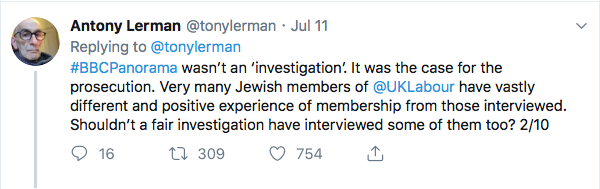
offering a very different perspective. The complete exclusion of their
voices on such an active controversial subject amounts to a gross breach
of the BBC’s impartiality requirements.
The two ‘expert’ witnesses, Alan Johnson and Dave Rich, whose views have been vigorously contested in public debate by other experts, were instead left unchallenged in the programme. For example, Alan Johnson’s account of antisemitism on the Left has been criticised
by Professor Jonathan Rosenhead, emeritus professor at LSE, for
confusing antisemitism with anti-Zionism. The programme failed to even
make reference to any such opposing views or perspectives. As the
founder of the Institute for Jewish Policy Research, Antony Lerman, tweeted:
3.3.17 We should normally identify
on-air and online sources of information and significant contributors
and provide their credentials, so that our audiences can judge their
status.
The BBC’s editorial guidelines also make very clear that the
credentials of sources and significant contributors should be made clear
to audiences, especially when dealing when covering matters of
political controversy. The unnamed witnesses featured in the programme
all have past or present affiliations with the Jewish Labour Movement, a
group known to be on the political right of Labour and opposed to
Jeremy Corbyn’s leadership. One of the key witnesses – Ella Rose – was
also a former Israeli embassy staffer. An investigation by Al Jazeera
in 2017 revealed that Israeli embassy official Shai Masot was actively
working within Labour to surreptitiously undermine Jeremy Corbyn’s
leadership (a complaint by Ms Rose about the Al-Jazeera documentary was rejected by Ofcom in October 2017). Nor was it mentioned that Alan Johnson, one of the programme’s two ‘expert’ witnesses, is an employee of BICOM,
an organisation which, like both JLM and the Israeli state, has made no
secret of its opposition to Jeremy Corbyn’s leadership of the Labour
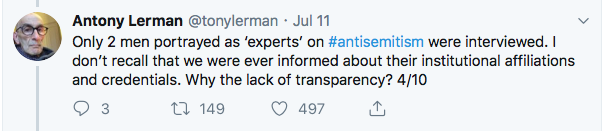
Party. None of these affiliations were mentioned by the Panorama programme. “Only 2 men portrayed as ‘experts’ on #antisemitism were interviewed”, tweeted Antony Lerman
once again. “I don’t recall that we were ever informed about their
institutional affiliations and credentials. Why the lack of
transparency?”
3.3.16 We must not knowingly and materially mislead our audiences with our content.
The programme’s central allegation was that the party leadership, and
those within the party’s governing body allied to the leadership, have
been actively intervening in the complaints process so as to both cause
undue delays and protect high profile individuals from sanction. In
making these allegations, the programme relied on two sources of
evidence: the eye-witness testimony of former staff working within
Labour’s compliance unit, and selective emails leaked by those staff.
In fact, a close examination of the material evidence (leaked emails)
strongly suggests that the reality of what happened was the exact
inverse of what was reported. For instance, one of the key witnesses of
the programme was Sam Matthews, former head of disputes in Labour’s
compliance unit. It is clear from leaked emails between him and Laura
Murray, a former aide of Jeremy Corbyn, that the leader’s office
intervened in an effort to both expedite investigations and recommend
suspension of key members under investigation. For instance, in respect
of council candidate Alan Bull (who posted an article on Facebook that
suggested the Holocaust was a hoax), Murray emailed Matthews in March 2018 recommending suspension:
In light of how bad his social
media comments are, and in light of other complaints about comments by
him received by the region, should he not be suspended pending
investigation?
Where the programme did feature leaked emails they were selectively
quoted out of context in a manner that was clearly and grossly misleading. For instance, the programme quoted Seamus Milne in a leaked email as stating that:
something’s going wrong, and we’re
muddling up political disputes with racism… I think going forward we
need to review where and how we’re drawing the line.
But the programme failed to draw attention to the fact that Milne was
referring specifically to antisemitic complaints directed against Jews
themselves, as a fuller quotation would have made clear:
if we’re more than very
occasionally using disciplinary action against Jewish members for
anti-Semitism, something’s going wrong, and we’re muddling up political
disputes with racism.
This profound misrepresentation was compounded by a wholly unfounded extrapolation from an email
sent by Labour’s current general secretary, Jennie Formby, in which she
was quoted as stating that the “NCC [National ConstitutionCommittee]
cannot be allowed to continue in the way that they are at the moment and
I will also be challenging the panel for the Jackie Walker case”.
The reporter, John Ware, then offers his own version of the content
of the email in a question put to the former Labour General Secretary,
now Lord Iain McNicol (and one of the 64 Labour peers who took out an advertisement in the Guardian accusing Jeremy Corbyn of having “failed the test of leadership” in relation to anti-semitism):
Reporter: So if you when as
General Secretary had been asked to talk to the NCC chair and say ‘You
know what, we’ve got this antisemitism panel coming up, I don’t want
these panelists, I want those panelists.’
But there is nothing in the email as shown to suggest that Jennie
Formby was seeking to pick a particular set of members. The words ‘I
don’t want these panelists, I want those panelists’, are a construction
by the reporter. He persists then with a claim that Jennie Formby knew
she was doing something ‘dubious’:
What Ms Formby’s email does suggest is that she knew that what was being contemplated was dubious.
His grounds for asserting this are that she has said she has deleted
the email. He notes that the reason she gives is that ‘too many eyes
were on her Labour address’. He cannot apparently see this as in anyway
reasonable, even though he has just put her email on Panorama.
It is entirely conceivable, as the Labour Party has claimed, that Formby was expressing a concern to ensure that the procedure for
dealing with complaints was efficient and effective, which is very much
within her remit of responsibility. There was nothing in the email
showing that she was seeking to select particular members of a panel,
let alone she was attempting to interfere in the actual decision-making
of the panel.
Finally, the programme relied exclusively on the eye-witness
testimony in relation to a particularly disturbing allegation of
antisemitism from former investigations officer Ben Westerman. In
reflecting on the conclusion to an interview with party members,
Westerman stated on the programme that:
The person got up to leave the
room, and then turned back to me and said, ‘where are you from?’ And I
said, ‘what do you mean, where am I from?’ And she said, ‘I asked you
where are you from?’ And I said ‘I’m not prepared to discuss this’. And
they said, ‘are you from Israel?’
In what appears to be a recording of the interview obtained by The Canary,
the actual exchange between Westerman and the member in question had
actually asked “what branch are you in?” and had made no reference to
Israel whatsoever.
CONCLUSION
The BBC has declined to respond to criticisms beyond stating
that it “stands by its journalism” and completely rejects “any
accusations of bias or dishonesty”. This is, in many ways, the most
serious failure: the failure to account for what appear to be, at best,
serious errors of judgement on the part of the journalists and editors
who produced the programme.
MRC values independent and investigative journalism as essential for
democracy. When leading broadcasters fall short of their own guidelines,
we should expect detailed responses and critical scrutiny. A one-sided
and misleading attack on Labour reveals an underlying bias against the
left that discredits its mission as a public service broadcaster.